


ABB ACS880-07-0293A-3 +R700 Cabinet-Built Industrial Drive for High-Performance Motor Control
ABB ACS880-07-0293A-3 Cabinet-Built Industrial Drive for Demanding Motor Control
ABB ACS880-07-0293A-3 is a cabinet-built member of the ACS880 industrial drive family. It is intended for applications that need controlled speed or torque from an AC motor together with an engineered enclosure, switching and protection arrangement. Typical uses include pumps, fans, conveyors, mixers, compressors, extruders, cranes, and process machinery where reliable operation and integration with the plant control system are important.
The “-3” voltage class, the 0293A current designation, cabinet construction, option code R700, and any additional project options must be evaluated as one configuration. Motor power depends on voltage, duty, overload requirement, switching frequency, ambient temperature, altitude, enclosure, and applicable standards. Select the drive from current ABB rating tables instead of converting the model current directly into a universal motor-kilowatt value.
Start with the motor and load profile
A technically useful inquiry includes the motor nameplate voltage, current, frequency, rated speed, power factor, efficiency, insulation class, and whether the motor is induction, permanent-magnet, or synchronous reluctance. The load profile should identify continuous torque, peak torque, acceleration time, deceleration time, starts per hour, low-speed operation, and expected regenerative energy. Long motor cables, output filters, hazardous-area motors, or multiple motors on one drive can change the selection.
For variable-torque pumps and fans, energy savings often come from reducing speed instead of throttling. Constant-torque conveyors and mixers demand a different overload review. Hoists, centrifuges, and fast-stopping machinery may require braking hardware or a regenerative solution. The drive and motor must be selected together with the mechanical process rather than as isolated electrical components.
| Engineering check | Project information |
|---|---|
| Requested drive | ACS880-07-0293A-3 +R700 |
| Supply | Voltage, frequency, short-circuit level, grounding system and harmonics limits |
| Motor | Full nameplate, cable length, motor type, duty and overload profile |
| Cabinet | IP rating, cooling, entry direction, dimensions, ambient temperature and altitude |
| Controls | Fieldbus, I/O, safety functions, encoder, braking and bypass requirements |
Power-system and cabinet considerations
Confirm available fault current, upstream protection, cable sizing, disconnecting method, EMC environment, harmonic requirements, and any transformer or generator limitations. Cabinet cooling must be designed for the installation room and actual ambient temperature. Maintain ABB’s required clearances and ventilation paths. Dust, conductive contamination, corrosive gas, humidity, altitude, and restricted airflow may require derating or additional environmental protection.
Control integration should define start permissives, speed or torque reference, process interlocks, emergency-stop architecture, safe torque off, feedback signals, fieldbus protocol, and behavior after power restoration. Safety functions must be designed and validated as part of the complete machine. Parameter backup, firmware records, motor identification, direction checks, and a controlled test at low speed help create a maintainable commissioning baseline.
Commissioning sequence and operational readiness
Before energizing the cabinet, verify protective earth, power and motor cable termination, phase identification, insulation-test procedures, auxiliary supply, control voltage, cooling fans, cabinet heaters if fitted, and all external interlocks. Disconnect or protect sensitive drive electronics before performing insulation resistance tests according to the hardware manual. Confirm that the motor and driven machine can rotate safely and that personnel are clear of moving equipment.
Enter motor nameplate data and verify the selected control mode. Check rotation at low speed before coupling the process or enabling automatic control. Test local and remote commands, reference scaling, minimum and maximum speed, current limits, acceleration and deceleration, fault reset logic, emergency stop, safe torque off, process permissives, and communications loss behavior. Under load, record supply voltage, motor current, DC-link condition, cabinet temperature, cooling operation, and any warnings. Save the final parameter backup and identify all project-specific changes so that a replacement control unit can be restored without guesswork.
What to send for quotation and replacement review
Provide the full ACS880-07-0293A-3 +R700 designation, quantity, supply details, motor nameplate, load description, duty cycle, enclosure requirement, site temperature and altitude, cable entry, motor-cable length, fieldbus, I/O, safety, braking, harmonic, EMC, certification, and documentation requirements. For a replacement, add cabinet dimensions, connection drawings, option labels, control program information, and photographs of the existing nameplate and terminals.
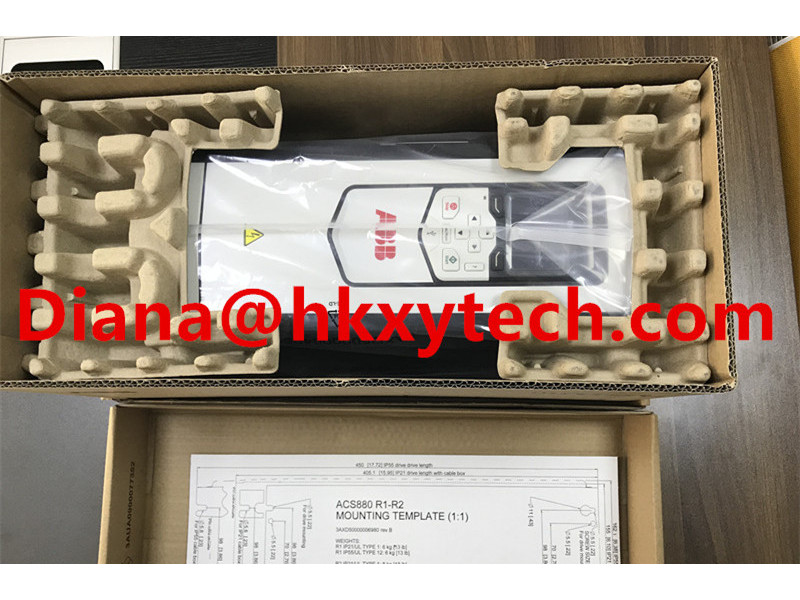
The photograph is a reference image of an ACS880 industrial drive package; it may show a different current rating or mechanical size. Cabinet appearance and included components vary by frame and options. Confirm the precise rating, dimensions, cooling, switchgear, and option content using the current ABB hardware manual and order documentation before installation.
