


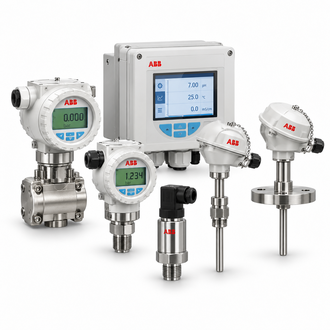
266MST-FCKC4B1L1B2I2C1: 266MST multisensor transmitter: differential pressure, static pressure and process setup
The ABB 266MST-FCKC4B1L1B2I2C1 is a representative order code in the 266MST multisensor differential-pressure family. ABB describes 266MST for flow, level, pressure and density applications, with a family base-accuracy reference of ±0.04% and high-static-pressure options. Exact limits depend on the installed sensor and the complete configuration.
Key technical data
| Technical item | Verified value / selection note |
|---|---|
| Representative designation | 266MST-FCKC4B1L1B2I2C1 |
| Measurement | Differential pressure with multisensor technology |
| Applications | Flow, level, pressure and density measurement, subject to configuration |
| Base accuracy | ±0.04% family reference; optional ±0.025% version may be available |
| High static pressure | Family options up to 41 MPa; exact sensor/code limits apply |
| Communications | HART, PROFIBUS PA and FOUNDATION Fieldbus family choices |
| Exact configuration | Verify sensor range, manifold, wetted parts and approvals |
The table summarizes family or catalog values for identification and initial selection. Confirm the nameplate, environmental limits, standards, revision and options for the exact device before procurement or engineering approval.
Application and system selection
For flow measurement, select the transmitter together with the primary element, fluid properties and expected operating range. For level service, account for tank geometry and density changes. Multisensor designs can provide additional process information, but the required variables and their host-system scaling should be specified before ordering.
Configuration and compatibility
Review the complete code for sensor span, process connections, manifold, fill fluid, materials, output protocol and certification. Compare the proposed device with the existing impulse piping and static-pressure envelope. Never treat a high-static family option as proof that a particular code meets the site’s pressure rating.
Related models and order-code references
The following designations are related catalog references, not automatic substitutes. Check each complete code, rating, connection, revision and application requirement before selecting a variant.
- 266MST.A.W.S.A.3.B.1.V1.E1.L1
- 266MST.C.C.K.A.6.J.1.L1.B2.M5.C1.H4
- 266MST.F.A.M.H.6.T.8-E1.L1.B5.I2.C5.H3
- 266MST.F.T.K.A.6.J.1.E1.L1.B2.M5
- 266MST.L.C.K.Q.4.A.1-EH.L1.T1.A1.W20
- 266MST.L.T.S.B.3.A.1.L1.B2.S2.M5.I1.C1
- 266MSTAWKA3B3E1L1B2
- 266MSTAWKC3B8L1B1I3C1Y1
- 266MSTCCKB3B2L1B1C1
- 266MSTCYSB5SH
- 266MSTLCKA4B3E1L1B2
- 266MSTLCKA4B8V3E1L1M5I1H3
- 266MSTLCKA6J8L1I1C1H3
Installation and commissioning
Mount the transmitter to a rated manifold or bracket, observe high- and low-side port orientation, and leak-test the pressure path using an approved method. Configure units, range and damping, then verify differential and static pressure separately where applicable. Test control-system scaling and alarms before enabling process control.
Replacement and procurement information
For a quotation or replacement review, provide the complete designation 266MST-FCKC4B1L1B2I2C1, the order code where applicable, serial or hardware revision, quantity, operating environment, connected equipment and required delivery date. Include a legible nameplate image and relevant wiring, loop or switchgear drawing so the exact interface and configuration can be checked.
Ask the supplier to confirm accessories, revision compatibility and any approved successor in writing. Do not select solely from a family name or product photograph. Follow the current ABB installation and safety instructions for the exact unit.
