


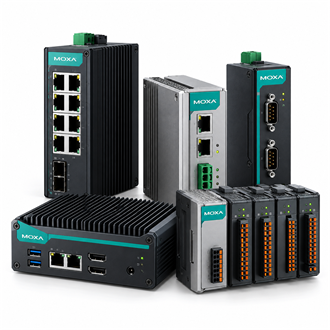
Moxa LM-7000H-4POE — Host-chassis, PoE and unused-slot checks for LM-7000H modules
| LM-7000H-4POE | 4 x 10/100BaseT(X) PoE / PoE+ ports |
|---|---|
| LM-7000H-DMY | 3 dummy modules for unused interface slots |
| Host platform | Supported PT-G7728/G7828 and MDS-G40xx families; verify exact chassis |
| PoE budget | Check system power module and attached-device load |
| Installation | Observe hot-swap and grounding procedures in the manual |
The LM-7000H-4POE is considered here as a modular Ethernet PoE interface module. Moxa lm-7000h-4poe is selected for the stated industrial application. confirm its exact model code, host compatibility, interfaces, power arrangement and site conditions before procurement or replacement.. Before selecting the LM-7000H-4POE, map the complete path from field signals and network boundaries to the host system, supply source and operating location.
Application fit
The LM-7000H-4POE selection should also account for maintenance access. Identify who owns firmware updates, where configuration backups are stored and how alarms reach the operations team. If several LM-7000H-4POE devices are deployed, keep one inventory row per physical unit with its location, address, attached equipment and validated configuration instead of relying on an unstructured label list.
Port and protocol review
Before issuing a purchase order for LM-7000H-4POE, ask the site team to verify the complete nameplate, target application, environmental range and required accessories. Confirm that the quantity covers the installed topology and any approved spare policy. This final review reduces avoidable substitutions and keeps the delivered LM-7000H-4POE aligned with the approved bill of materials.
Commissioning sequence
Keep the LM-7000H-4POE design within documented operating limits and the project's cybersecurity and safety procedures. Apply only approved network services, protect management access, use the required grounding and isolation practices, and validate the finished installation against current manufacturer documentation. The LM-7000H-4POE should be treated as one element in a system-level design, not as a substitute for the system review.
Replacement record
When the LM-7000H-4POE is part of a migration, record the old interface and behavior before disconnection. Note timing, addressing, scaling and fail-state behavior, then compare these with the new LM-7000H-4POE configuration under a controlled test. Preserve a rollback path until the application owner accepts the observed result and the maintenance team has the final record.
Related models
The information needed to quote a LM-7000H-4POE accurately includes the full model code, quantity, installation country, host platform, network or fieldbus details, environmental conditions and any required accessories. Include a wiring sketch or port schedule where useful. This lets a reviewer confirm whether the selected LM-7000H-4POE and its variant align with the actual installation.
Application fit
For a LM-7000H-4POE enquiry, begin with the device that must connect, the protocol on each side and the owner of the communication session. Record the required direction of data flow and identify whether the LM-7000H-4POE is expected to initiate requests, respond to a controller or simply pass traffic. These details determine a workable configuration more reliably than a model-family name alone.
Port and protocol review
The physical design around LM-7000H-4POE should be checked before commissioning. Confirm connector type, cable medium, termination, grounding, power availability and any environmental suffix. A nominal protocol match does not guarantee the cable or electrical interface is compatible; document each endpoint and its pin or port assignment before energizing the LM-7000H-4POE.
Commissioning sequence
During integration, configure the LM-7000H-4POE against an approved network plan rather than assigning addresses informally at the cabinet. Capture VLAN or subnet boundaries where applicable, device names, serial settings, firmware baseline and the expected diagnostics. A commissioning record makes later service work on the LM-7000H-4POE much faster and helps separate wiring faults from application mapping errors.
Replacement record
A staged acceptance test for LM-7000H-4POE should prove the local link first, then the protocol exchange and finally the full application value. Compare a known input or register with the value at the consuming system, check alarm behavior, and record recovery after a controlled link interruption where site procedures permit. Save the result with the exact LM-7000H-4POE identifier.
Related models
For replacement planning, retain the LM-7000H-4POE part code, suffix, connector details, firmware and accessory list alongside the as-built drawing. If the site has an established configuration, compare it with the proposed LM-7000H-4POE replacement before changing the device; small suffix differences can affect temperature, optical interface, power input or included cable options.
Related models
- LM-7000H-4POE
- LM-7000H-DMY
