


Endress+Hauser FMP51-BCACCDACA4AFJ+F3JAOB Levelflex Guided Radar Level Transmitter for Process Tanks
Endress+Hauser Levelflex FMP51 Guided-Wave Radar Level Transmitter
The Endress+Hauser FMP51-BCACCDACA4AFJ+F3JAOB is a configured Levelflex FMP51 guided-wave radar transmitter for continuous level and interface measurement in demanding process vessels. The FMP51 family is intended for liquids, pastes, and slurries and can maintain reliable measurement in applications with moving surfaces, foam, internal tank structures, changing media, gas blankets, or vapor. Its guided-wave radar principle sends microwave pulses along a probe and evaluates the reflected signal from the product surface or interface.
Endress+Hauser offers the FMP51 with rod, rope, and coaxial probe designs. Published family specifications include process temperatures from −50 to +200 °C and pressure from vacuum to 40 bar. Maximum measuring distance depends on probe type and dielectric properties: rod probes are listed up to 10 m, rope probes up to 45 m under applicable conditions, and coaxial probes up to 6 m. Published accuracy is typically ±2 mm for rod and coaxial probes and for rope probes up to 15 m, with different values possible for longer rope probes and specific configurations.
Typical Applications and Benefits
- Continuous liquid level measurement in storage, buffer, reactor, and process tanks.
- Interface measurement where two liquid phases have suitable dielectric contrast.
- Applications with foam, vapor, changing temperature, or turbulent surfaces.
- Vessels containing internal structures that can complicate free-space radar measurement.
- High-temperature or elevated-pressure duties within the selected process connection and probe rating.
- Replacement and modernization projects requiring digital diagnostics and process integration.
The probe guides the microwave energy toward the product, which can make guided-wave radar a practical choice where nozzle geometry, agitation, or tank internals challenge other measurement methods. Measurement is generally less dependent on density than hydrostatic level measurement, and the technology does not require moving mechanical parts. The final suitability still depends on process medium, dielectric constant, coating tendency, buildup, foam, probe loading, nozzle design, and installation geometry.
Order-Code and Probe Selection
The complete code FMP51-BCACCDACA4AFJ+F3JAOB represents a configured instrument and must be checked against Endress+Hauser order information or by serial-number verification. Buyers should confirm probe type and length, process connection, wetted materials, housing, cable entry, display, output and communication protocol, power supply, hazardous-area approval, overfill or safety requirement, and any supplied certificate. The FMP51 family name alone is not sufficient to define a direct replacement.
Rod probes are often selected for shorter measuring ranges and straightforward installation. Rope probes can serve tall vessels but require adequate clearance and attention to tensile loading, movement, and anchoring where applicable. Coaxial probes provide a controlled measurement path and may suit low-dielectric media, but they require compatibility with viscosity, buildup, and cleaning needs. Probe material, process seal, and connection must be compatible with the fluid, pressure, and temperature.
Installation and Commissioning Considerations
Installation should follow the manufacturer’s guidance for nozzle diameter and height, distance from the vessel wall, clearance from internal structures, and probe alignment. The probe must not contact agitators, heating coils, ladders, or moving internals during operation. For rope probes, consider lateral movement and mechanical load during filling or agitation. Buildup, bridging, and strong process forces should be evaluated before the mounting point is finalized.
Commissioning requires the correct empty and full calibration distances, probe length, tank geometry, medium group or dielectric behavior, blocking distance, output scaling, and alarm response. A mapping or interference-suppression procedure may be required to manage fixed echoes. Verify the indicated level at several known conditions and check the 4–20 mA, HART, fieldbus, or other configured communication output against the control system.
Maintenance and Buyer Verification
Guided-wave radar instruments normally require limited routine maintenance, but the probe and process connection should be inspected when the service can create coating, deposits, corrosion, or mechanical damage. Diagnostic history and echo information can help distinguish a genuine level change from signal loss or interference. Configuration backups, serial numbers, firmware information, calibration records, and approval documents should be retained for future replacement and troubleshooting.
For a replacement project, compare the existing instrument’s full order code, serial number, probe design, probe length, process connection, mounting space, communication, and approval markings. A transmitter with a similar blue housing may belong to a completely different Endress+Hauser measurement family. Do not assume interchangeability based on appearance.
Important Image Mismatch Notice
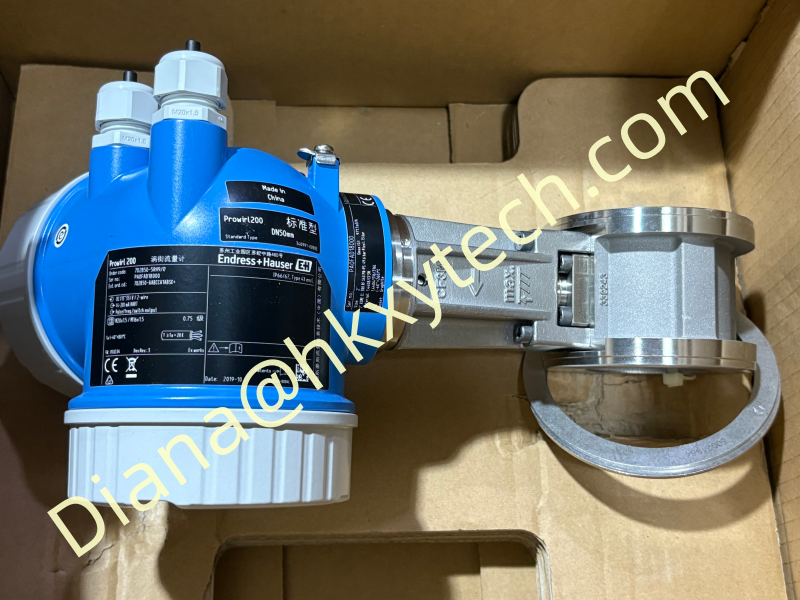
The supplied photograph does not show a Levelflex FMP51 guided-wave radar level transmitter. The visible label identifies a Proline Promag W 200 electromagnetic flowmeter, and the source filename references 7D2B50-5RH9. The image is published only as the customer-designated Endress+Hauser inventory reference. It must not be used to identify the requested FMP51-BCACCDACA4AFJ+F3JAOB or to confirm probe, process connection, electronics, or approvals.
For an accurate quotation, provide clear photographs of the actual FMP51 nameplate and probe, the complete model and serial number, probe length, process medium, measuring range, tank dimensions, temperature, pressure, process connection, output protocol, approval requirements, quantity, and destination. Final supply should be accepted only after the configured order code and manufacturer documentation match the application.
